Tracking a Strength Training Program With More Than Your PRs
Track strength training progress beyond your PRs: training volume, effort, and body composition metrics like muscle mass, body fat, and segmental balance.
By TANITA US

A personal record is the most satisfying number in strength training. It's also one of the least complete. Your one-rep max on a single lift tells you what you could do on one day, in one movement pattern, under one set of conditions. It says nothing about whether you built muscle, lost fat, trained one side harder than the other, or simply got better at the lift.
If you want to know whether your program is actually working, you need a wider dashboard. This guide covers what to track alongside your PRs, from the training log to your body composition, and how to read those numbers together so they tell you something useful.
The short answer: track three layers. Your performance (PRs and rep records), your training inputs (volume, effort, and consistency), and your body (muscle mass, body fat percentage, and segmental balance). PRs tell you that something changed. The other two layers tell you what, and why.
Why PRs Alone Can Mislead You
PRs are a lagging, noisy, and narrow signal. That doesn't make them useless. It makes them one input among several.
- Early strength gains are mostly your nervous system. In the first weeks of a new program, you get stronger largely by learning to recruit and coordinate more muscle fibers, not by adding much muscle. Hypertrophy begins early but contributes more as training goes on (Folland & Williams, Sports Medicine). A fast-rising PR in month one is real progress, just not proof of muscle growth.
- PRs reward skill and specificity. Get better at the bench press and your bench PR climbs, partly because you've grooved the movement. That's worth celebrating, but it can rise even while total muscle mass stays flat.
- PRs are noisy day to day. Sleep, food, stress, warm-up, and even who's watching move your top-end performance. One bad session isn't regression, and one great one isn't a new baseline.
- PRs slow down, and the plateau can hide real change. After the beginner phase, maximal strength rises slowly. Months can pass between records while your body composition keeps improving underneath.
- PRs say nothing about fat. Many lifters train to change how their body looks and functions, not just what they can lift. A PR can't tell you whether you're gaining muscle, gaining fat, or both.
- PRs only test the lifts you test. A squat PR doesn't reveal that your right leg carries more muscle than your left, or that your upper body is lagging behind.
None of this is an argument against chasing records. It's an argument for not letting them be your only feedback.
Layer One: Track Your Training Inputs, Not Just Your Outputs
A PR is an output. The inputs are what you control, and they're what you adjust when progress stalls. A good training log captures four of them.
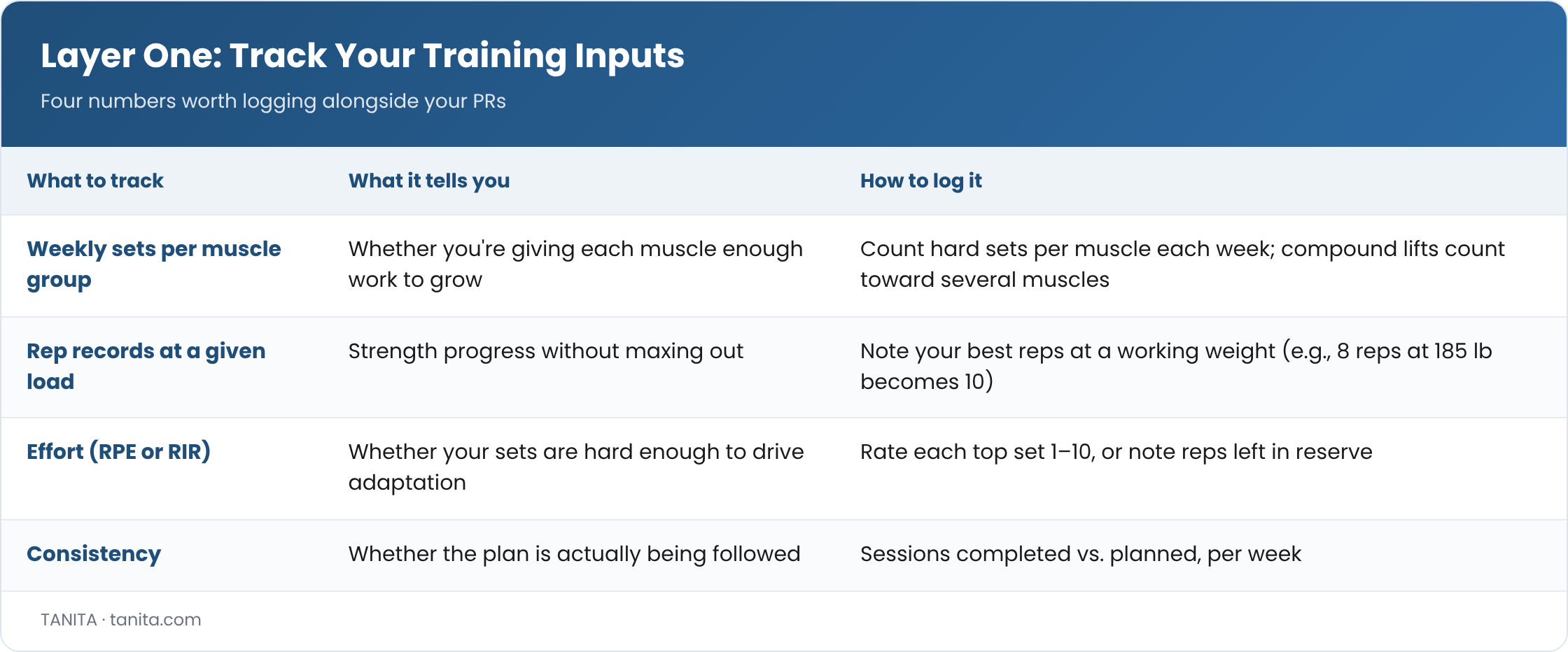
Volume is the input with the strongest evidence behind it. A February 2026 meta-regression from Florida Atlantic University pooled 67 studies and 2,058 participants and found a dose-response relationship between weekly sets and both muscle growth and strength, with diminishing returns as volume climbs (summary via train.fitness (https://train.fitness/personal-trainer-blogs/not-all-sets-are-created-equal)). In plain terms: going from very few weekly sets to a moderate number matters a lot; piling on more and more matters progressively less.
Rep records are the underrated PR. Lifting a working weight for more reps than last month is a strength gain, and it's safer and easier to repeat than a true one-rep max. Track both.
Effort keeps your volume honest. Ten sets stopped far from failure aren't the same stimulus as ten hard ones. Rating effort (RPE) or noting reps left in reserve (RIR) tells you whether your logged volume is real.
Consistency is the multiplier. The best-designed program does nothing in the weeks you skip. A simple completed-vs-planned count is often the most revealing number in the whole log.
Layer Two: Track What Your Training Is Doing to Your Body
Your training log shows the work. Body composition shows the result. This is the layer most lifters skip, and it's the one that explains a stalled PR or a scale that won't budge.
Strength training changes your body in ways the bathroom scale can't see. A meta-analysis of 54 randomized trials found that resistance training alone, without dieting, reduced body fat percentage by about 1.5 points and also reduced visceral fat compared with no exercise (Wewege et al., Sports Medicine). Meanwhile, you're adding muscle. Lose fat and gain muscle at the same rate, and your weight doesn't move at all. That's body recomposition, and only a body composition reading will show it.
Here are the measurements worth watching, in order of importance for most lifters.
Muscle mass
The headline number for anyone training for strength or size. Watch the trend over months, not weeks, because real muscle gain is slow, often a fraction of a pound per month after the first year. A rising muscle mass line with a flat PR line means the program is working; strength usually catches up.
Body fat percentage
The other half of recomposition. Because it's a percentage, it moves when you gain muscle even if fat mass stays the same. Read it alongside muscle mass to know which side of the equation is changing.
Segmental muscle and fat
This is where body composition gets specific to strength training. Segmental monitors estimate muscle and fat separately for each arm, each leg, and the trunk. That reveals imbalances a PR never will: a dominant leg carrying more muscle, or arms growing while legs stall. In one study of trained women, changes in segmental bioelectrical readings tracked with changes in segmental lean tissue measured by DXA over an eight-week program (Journal of the International Society of Sports Nutrition).
Visceral fat rating
The fat stored around your organs, and the one most tied to metabolic health. Resistance training lowers it, so it's a useful health marker even if your goals are purely performance-driven. On TANITA monitors, a rating of 1–12 is considered healthy.
Physique rating
A single score that combines muscle and fat into one assessment of body type. It's a quick way to see whether you're moving toward a more muscular, leaner build over time, without reading every number separately.
Total body water
Not a goal in itself, but essential context. Muscle holds a lot of water, so hydration shifts can make muscle mass and body fat readings jump. If both move sharply on the same morning, check this number before drawing conclusions.
Phase angle (professional devices)
Available on professional-grade analyzers, phase angle is a raw bioelectrical value linked to cell integrity and muscle quality. It rises with training: a meta-analysis of trials in older adults found resistance training increased phase angle by about half a degree (Campa et al.). Coaches and clinicians use it to track muscle quality, not just quantity.
Available metrics vary by model. Check your product manual to confirm what your specific monitor measures.
How to Measure Body Composition Around Your Training
The single biggest mistake lifters make with a body composition monitor is measuring after a workout. Sweat loss lowers body water, which makes body fat read higher and muscle mass read lower. The session looks like it cost you muscle. It didn't. (We cover this and other everyday culprits in Why Did My Body Fat Go Up Overnight?)
For readings you can actually compare:
- Measure first thing in the morning, after using the bathroom and before eating, drinking, or training.
- Never measure straight after a session. Wait several hours, or measure the next morning. Very hard leg days can shift fluid for longer, so the morning after may still read a little off.
- Keep conditions the same. Bare, dry feet, a hard floor, similar hydration the night before.
- Use the right mode. Many TANITA monitors offer an Athlete mode for people who train intensively, typically around 10 or more hours a week. It uses reference data built for highly trained bodies, which hold more water in their muscle. Use it only if you fit the criteria in your manual, and use it every time.
- Measure weekly, judge monthly. Weekly readings at the same time are plenty. Make decisions on four-week trends, not single readings.
- Line it up with your training blocks. Take a baseline at the start of each program or mesocycle and compare at the end. That ties every body change to the plan that produced it.
Reading the Signals Together
No single number tells you whether your program is working. The combination does. Here's how to read the most common patterns over a four-to-eight-week block.
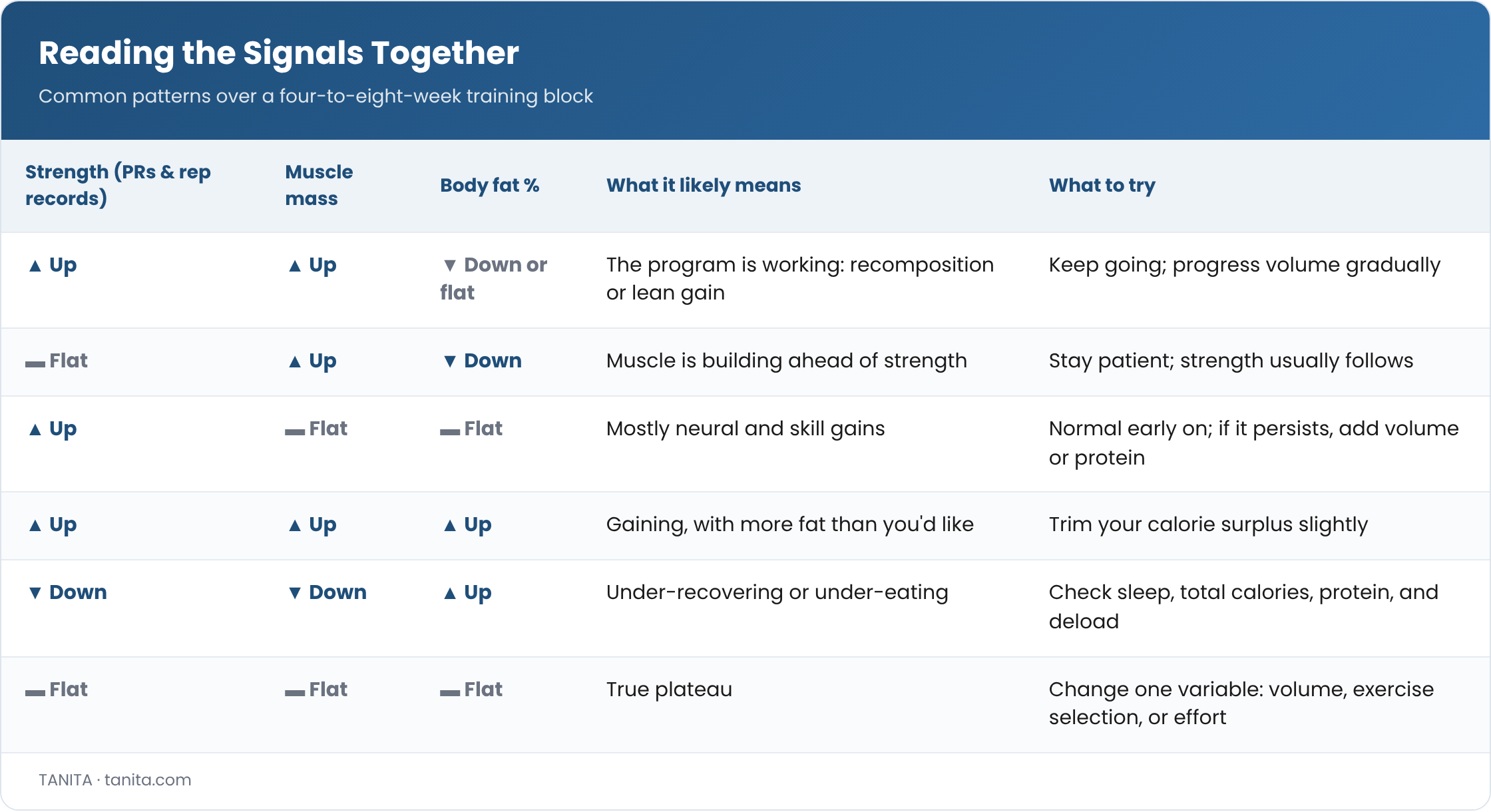
Two more patterns worth knowing:
- Segmental imbalance growing. If one limb's muscle mass is rising faster than the other, add unilateral work (split squats, single-arm rows) and let your weaker side set the reps.
- Everything swings at once. If muscle and fat jump in opposite directions overnight, look at body water first. That's hydration, not tissue.
Frequently Asked Questions
How do I track strength training progress besides PRs? Track three layers: performance (PRs and rep records at working weights), training inputs (weekly sets per muscle, effort, and sessions completed), and body composition (muscle mass, body fat percentage, and segmental balance). Together they show what changed and why.
How do I know if I'm gaining muscle if the scale isn't moving? A stable weight can hide fat loss and muscle gain happening at the same time. A body composition monitor shows muscle mass and body fat separately, so you can see recomposition the scale misses.
Why am I getting stronger but not seeing muscle gain? Early strength gains come largely from your nervous system learning to recruit muscle more effectively. Muscle growth starts early too, but it's slower and becomes a bigger share of your progress over months.
How often should I measure body composition when strength training? Weekly, at the same time of day, is enough. Base decisions on four-week trends and compare readings at the start and end of each training block.
Should I measure body composition before or after a workout? Before, ideally first thing in the morning. Sweat loss after training lowers body water, which makes body fat read higher and muscle mass read lower than they really are.
What is a good number of sets per week for muscle growth? Research shows more weekly sets per muscle group produce more growth, with diminishing returns at higher volumes. Most lifters do well starting moderate and adding sets gradually while tracking results.
Can a body composition scale show muscle imbalances? Segmental body composition monitors estimate muscle and fat in each arm, each leg, and the trunk separately, which can reveal side-to-side or upper-to-lower imbalances.
Awareness Is Where It Starts
At TANITA, we believe healthy living starts with awareness: knowing your numbers and building simple routines you can actually sustain.
Your PRs will always be the most exciting numbers in your training. Keep chasing them. But let them sit alongside the numbers that explain them: the sets you put in, how hard you worked, and what's happening to the muscle and fat underneath. That's how a stalled bench press stops being a mystery and starts being a clue.
At the start of your next training block, log your volume, step on your TANITA for a baseline, and set a date to check back in four weeks. Then let the whole dashboard tell you what's working.
This article is for general educational purposes and is not medical advice. Body composition measurements are estimates and are not clinical diagnostic tools. Before beginning a new exercise or nutrition program, consult a qualified healthcare or fitness professional.
Related reading: Muscle Mass, Explained · Difference Between Segmental and Non-Segmental Analyzers · Why Do My Measurements Change Throughout the Day? · Visceral Fat, Explained
By TANITA US
TANITA US is the North American division of TANITA Corporation, the global pioneer and industry leader in Bioelectrical Impedance Analysis (BIA) technology. Founded in Japan in 1944, TANITA has more than 80 years of expertise in developing precision measurement tools and remains the world’s most trusted name in body composition assessment, serving medical professionals, researchers, athletes, and health-focused consumers in over 120 countries.