What Muscle Does for Your Metabolism
Does muscle really boost your metabolism? Learn how many calories muscle burns at rest, why it matters for blood sugar, aging, and weight loss, and how to build it.
By TANITA US

"Muscle burns more calories than fat." It's one of the most repeated lines in fitness, and it's true. It's also usually exaggerated — and the exaggeration hides the parts of the story that matter most.
Muscle does raise your metabolism, but not by the dramatic amount the ads suggest. Its bigger contributions are quieter: it's where most of your blood sugar goes after a meal, it's the tissue you lose first when you diet hard, and it's the main reason metabolism seems to slip as you get older. Here's what the research actually says, and what it means for you.
The short answer: At rest, a pound of muscle burns roughly 6 calories a day, compared with about 2 for a pound of fat. That makes muscle around three times more metabolically active than fat — but a few pounds of new muscle adds tens of calories a day, not hundreds. Muscle's real metabolic value is that it handles most of your blood sugar, protects your resting metabolic rate during weight loss, and drives much of the change in metabolism as you age.
What Is Metabolism, Really?
Your metabolism is every chemical process your body uses to turn food into energy and keep you alive. When people talk about a "fast" or "slow" metabolism, they usually mean how many calories you burn in a day. That total has three parts:
- Basal or resting metabolic rate (BMR/RMR). The energy you burn doing nothing at all — keeping your heart beating, your brain working, your cells repairing themselves. For most people this is the largest share by far, roughly two-thirds to three-quarters of daily calories.
- Physical activity. Everything from a workout to walking to the car, fidgeting, and standing at your desk. This is the most variable part, and the one you control most directly.
- The thermic effect of food. The energy it takes to digest and process what you eat — typically around a tenth of your daily total, and higher for protein than for fat or carbohydrate.
Muscle shows up in all three. It's part of the tissue that sets your resting rate, it's the engine behind every movement you make, and it's built and repaired from the protein you eat. That's why it gets so much credit — and why it's worth understanding precisely.
How Many Calories Does Muscle Burn?
At rest, skeletal muscle burns about 13 calories per kilogram per day — roughly 6 calories per pound. Fat tissue burns about 4.5 calories per kilogram, or roughly 2 calories per pound. These figures come from organ-by-organ research that pairs MRI measurements of each tissue with measured resting metabolism, and they've held up across men, women, and different age groups.
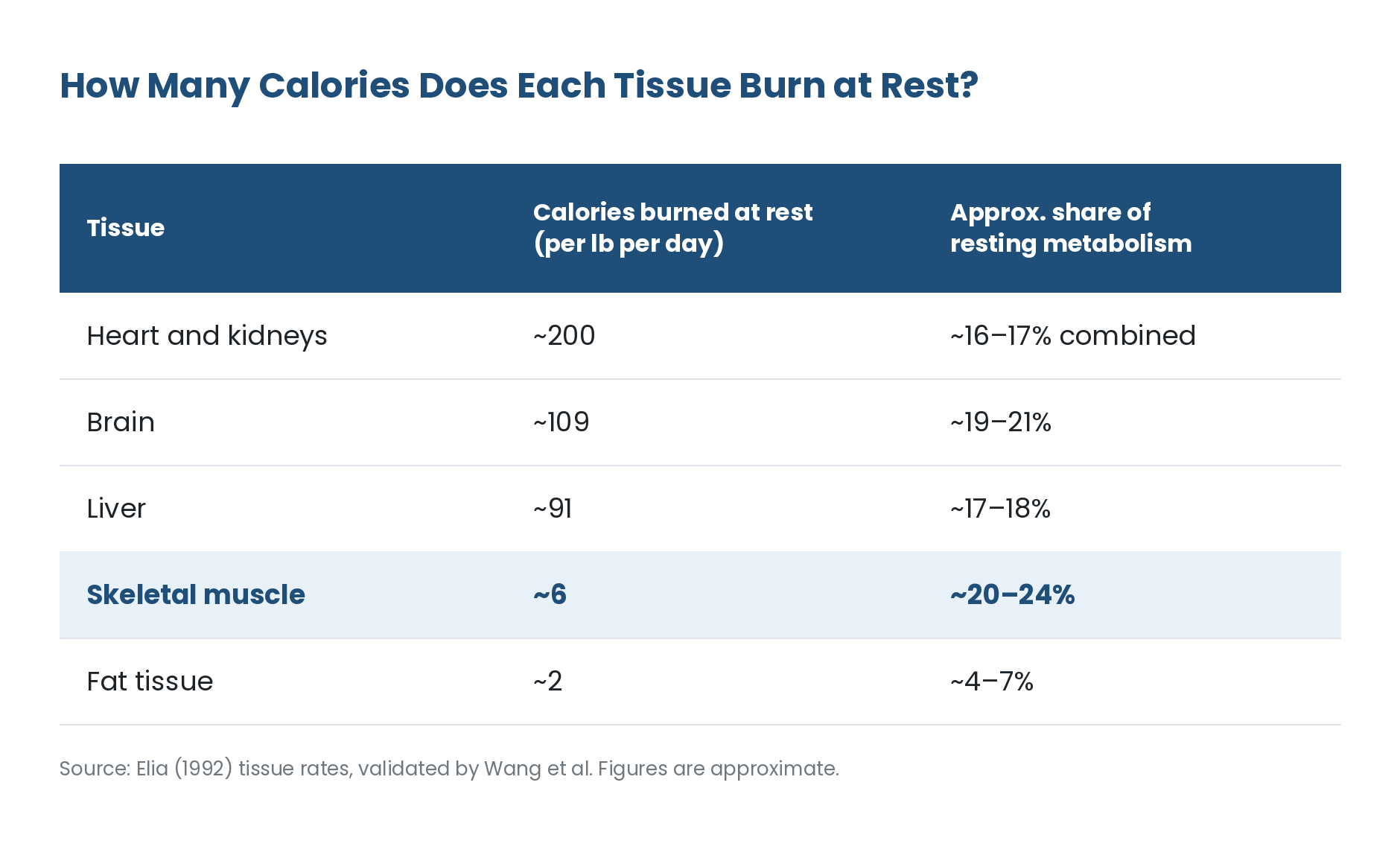
Muscle is about three times more active than fat — but it isn't a furnace. The popular claim that a pound of muscle burns 50 calories a day overstates it by nearly tenfold. Add five pounds of muscle and your resting burn rises by about 30 calories a day from that tissue alone. Meaningful over a year; not a license for dessert.
Muscle still matters because there's so much of it. Your heart and liver are far hungrier per pound, but they're small. Skeletal muscle is the largest tissue in most bodies, so even at a modest rate per pound it accounts for around a fifth to a quarter of everything you burn at rest — more than any single organ.
Does strength training raise your resting metabolism?
Yes, and by more than the arithmetic above predicts. In a widely cited review, several weeks of resistance training raised resting metabolic rate by roughly 7%, alongside about 1.4 kg (3 lb) of lean mass gained and 1.8 kg (4 lb) of fat lost. Part of the extra comes from the work of rebuilding muscle after training: remodeling stressed tissue is energy-intensive and can keep resting burn elevated for up to about three days after a session.
The practical upshot is that the habit of training — not just the muscle it leaves behind — keeps your metabolism higher.
Why Muscle Matters More Than the Calorie Count Suggests
If muscle only added 6 calories a pound, it would be a footnote. Its real metabolic importance lies elsewhere.
- Muscle is your body's main blood sugar sink. Skeletal muscle takes up roughly 80% of the glucose cleared from your blood after a meal. More muscle — and more active muscle — gives that sugar somewhere useful to go. When muscle becomes insulin resistant, blood sugar control suffers, which is why muscle sits at the center of type 2 diabetes research.
- Muscle protects your metabolism when you lose weight. Every diet costs some lean tissue. Lose a lot of muscle along with fat and your resting burn drops further than your new weight alone explains, which makes regaining easier. Keeping muscle during weight loss is one of the most effective ways to make the loss stick — a point that matters even more for anyone on GLP-1 medications.
- Muscle makes the active part of metabolism possible. Movement is the most flexible part of your daily burn, and muscle is what does the moving. Stronger people tend to move more, tire less, and stay active longer.
- Muscle quality matters, not just quantity. Muscle that's regularly used is more responsive to insulin and better at burning fuel than muscle of the same size that sits idle. Training improves both.
In other words: the calories are the smallest part of what muscle does for your metabolism.
Does Metabolism Slow Down With Age?
Less than most people think, and later. A landmark 2021 study in Science measured daily energy expenditure in more than 6,400 people aged 8 days to 95 years across 29 countries. Once body size and composition were accounted for, metabolism held remarkably steady from about age 20 to 60. The meaningful decline came after 60.
So why does it feel like metabolism drops in your thirties and forties? For most people, the answer is muscle. Inactive adults lose an estimated 3% to 8% of their muscle mass per decade after 30. Less muscle means a slightly lower resting burn, less capacity for activity, and poorer blood sugar handling. Fat creeps up while the bathroom scale barely moves — and the sense that "my metabolism quit" follows.
That's encouraging, because muscle loss responds to training at any age. Studies of resistance training have shown lean mass gains into people's eighties and nineties. The age-related slide isn't fixed; much of it is optional.
How to Build and Protect Muscle for a Healthier Metabolism
The habits that support muscle are simple. The hard part is doing them for long enough to see results.
Strength train two to three times a week. This is the non-negotiable. Weights, machines, resistance bands, or bodyweight all work. Prioritize compound movements — squats, lunges, hinges, presses, rows — that load several large muscle groups at once, and gradually make them harder as you get stronger.
Eat enough protein, spread across the day. Protein is the raw material for muscle repair, and it costs more energy to digest than carbohydrate or fat. Most active adults do better aiming for a solid portion at each meal rather than loading it all at dinner.
Don't crash diet. Severe calorie restriction strips muscle along with fat, lowering the resting burn you're trying to protect. A moderate deficit, paired with strength training and adequate protein, preserves far more lean tissue.
Keep moving between workouts. Walking, stairs, and standing don't build much muscle, but they keep it active and insulin-sensitive, and they add up to more daily calories than most people expect.
Sleep and recover. Muscle is rebuilt between sessions, not during them. Short sleep and chronic stress both work against that repair.
Start where you are, especially after 50. It's never too late. Older adults gain strength and muscle from training, often faster in relative terms than younger people, and the payoff in mobility and independence is large.
How to Track Muscle and Metabolism at Home
The bathroom scale can't tell you any of this. Lose five pounds of fat and gain three pounds of muscle and it reports a two-pound drop — the best possible outcome, disguised as a slow week.
Body composition is what shows the real picture. TANITA body composition monitors use bioelectrical impedance analysis (BIA) to estimate how much of your weight is muscle and how much is fat, and many models also report BMRand metabolic age — the two numbers that translate your muscle into metabolic terms. Watching them together tells a clear story: when muscle mass trends up and fat trends down, BMR usually rises and metabolic age falls.
A few habits make that trend trustworthy:
- Measure at the same time and under the same conditions — ideally first thing in the morning, before eating or training.
- Don't measure right after a workout. Sweat loss temporarily lowers body water, which can make muscle mass read lower than it is.
- Judge by weeks, not days. Muscle builds slowly; a weekly reading or a seven-day average is far more meaningful than any single morning.
Available metrics vary by model — check your product manual to confirm what your monitor measures.
Frequently Asked Questions
Does muscle increase metabolism? Yes. Muscle burns about three times more calories at rest than fat, and strength training has been shown to raise resting metabolic rate by roughly 7% over several weeks. The effect is real but modest; muscle's bigger metabolic benefits are blood sugar control and protecting your metabolism during weight loss.
How many calories does a pound of muscle burn per day? About 6 calories at rest, compared with about 2 for a pound of fat. Claims of 30 to 50 calories per pound are not supported by research.
Is muscle more metabolically active than fat? Yes, roughly three times more per pound. Because most people carry far more muscle than any single organ, skeletal muscle accounts for about a fifth to a quarter of resting metabolism.
Can building muscle help with weight loss? It helps most by protecting what you have. Strength training during weight loss preserves muscle, keeps resting metabolism higher, and makes the loss easier to maintain. It also improves how your body handles blood sugar.
Does metabolism slow down with age? Research shows metabolism stays fairly stable from about 20 to 60 once body size is accounted for, then declines more noticeably. Much of the slowdown people notice in midlife comes from gradual muscle loss, which strength training can slow or reverse.
What's the best exercise to boost metabolism? Resistance training two to three times a week, combined with regular aerobic activity and plenty of everyday movement. Strength work builds and preserves muscle; aerobic exercise and daily movement add to calories burned and support heart health.
How can I tell if I'm gaining muscle? A body composition monitor estimates muscle mass separately from fat, so you can see gains the scale hides. Many models also report BMR and metabolic age. Measure under consistent conditions and follow the trend over weeks.
Awareness Is Where It Starts
At TANITA, we believe healthy living starts with awareness: knowing your numbers and building simple routines you can actually sustain.
Muscle won't turn your body into a calorie furnace, and it doesn't need to. What it does is steadier and more valuable: it holds up your resting metabolism, gives your blood sugar somewhere to go, and protects you from the slow slide that most people mistake for aging. Step on your TANITA, note your muscle mass and BMR as a baseline, and give your strength training a few months. The scale may barely move. The numbers that matter will.
This article is for general educational purposes and is not medical advice. Body composition measurements are estimates and are not clinical diagnostic tools. Before beginning a new exercise or nutrition program, consult a qualified healthcare or fitness professional.
Related reading: Muscle Mass, Explained · Metabolic Age, Explained · Weighing the Risks + Benefits of Weight Loss Shots · Tips for Sustainable Belly Fat Reduction
By TANITA US
TANITA US is the North American division of TANITA Corporation, the global pioneer and industry leader in Bioelectrical Impedance Analysis (BIA) technology. Founded in Japan in 1944, TANITA has more than 80 years of expertise in developing precision measurement tools and remains the world’s most trusted name in body composition assessment, serving medical professionals, researchers, athletes, and health-focused consumers in over 120 countries.