How to Measure Body Fat Accurately: Comparing BIA, DEXA, Skinfolds, BMI and More
Understanding your body goes far beyond the number on the scale. This guide breaks down today’s leading body fat and body composition measurement methods—what they are, how they work, and which ones deliver the most reliable insights for health, fitness, and long-term progress. From traditional techniques like hydrodensitometry and skinfold calipers to advanced technologies such as DEXA and Bioelectrical Impedance Analysis (BIA), including TANITA’s fast, non-invasive leg-to-leg system, we compare accuracy, comfort, cost, and practicality. Whether you're a clinician, coach, or consumer, this overview helps you choose the right tool to track meaningful changes in body fat, muscle, and overall wellness.
By TANITA US
Adapted from TANITA’s research brochure “Primary Methods of Determining Body Fat” and updated with current insights.
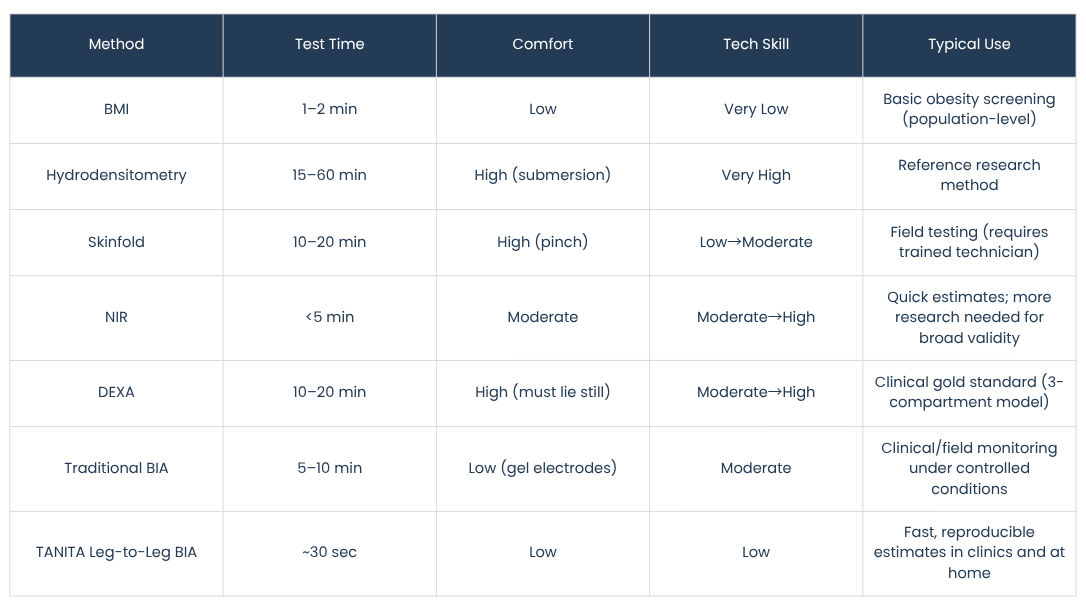
Understanding the difference between body fat reduction and simple weight loss starts with accurate measurement. This guide explains the leading body composition methods—how they work, test time, comfort level, costs, and reliability—so clinicians, coaches, and consumers can choose the right tool for monitoring progress.
Quick Comparison of Body Fat Methods
Body Mass Index (BMI)
BMI is calculated from height and weight to screen for obesity at the population level. It does not differentiate between fat and lean mass and can misclassify athletes (high muscle, low fat) or sedentary individuals (normal BMI, high fat). Best used as a simple screening tool, not a body composition measurement.
Hydrodensitometry (Underwater Weighing)
Considered a classic reference method, hydrodensitometry measures body density by comparing weight in air vs. underwater following full exhalation. It requires multiple immersions and technician expertise; discomfort and equipment cost limit its routine use.
Skinfold Measurements (Anthropometry)
Using calipers, a trained technician pinches skinfolds at 1–21 sites. Accuracy depends on technique, site selection, duplicate readings, and equations used. It’s portable and affordable, but precision declines for very lean and obese individuals and for novice users.
Near-Infrared Interactance (NIR)
A fiber-optic probe measures tissue characteristics to ~1 cm depth; results combine with height, weight, frame size, and activity level. It’s quick and non-invasive, but research indicates additional validation is needed for broad accuracy in body fat estimation.
Dual-Energy X-Ray Absorptiometry (DEXA)
DEXA uses a three-compartment model (bone mineral, lean soft tissue, and fat mass), scanning the entire body in one pass to assess both total adiposity and regional distribution. It delivers high reliability and is widely used in clinical and research settings.
Traditional Bioelectrical Impedance Analysis (BIA)
With traditional BIA, the user reclines while gel electrodes on the hand and foot measure the resistance of a safe electrical signal through the body. Reliability is strongest under consistent hydration and testing conditions, and accuracy depends on the equations used. Advanced approaches (e.g., phase angle, multi-frequency) continue to evolve for assessing fluid status and compartmentalization.
TANITA Leg-to-Leg BIA (Fast, Non-Invasive)
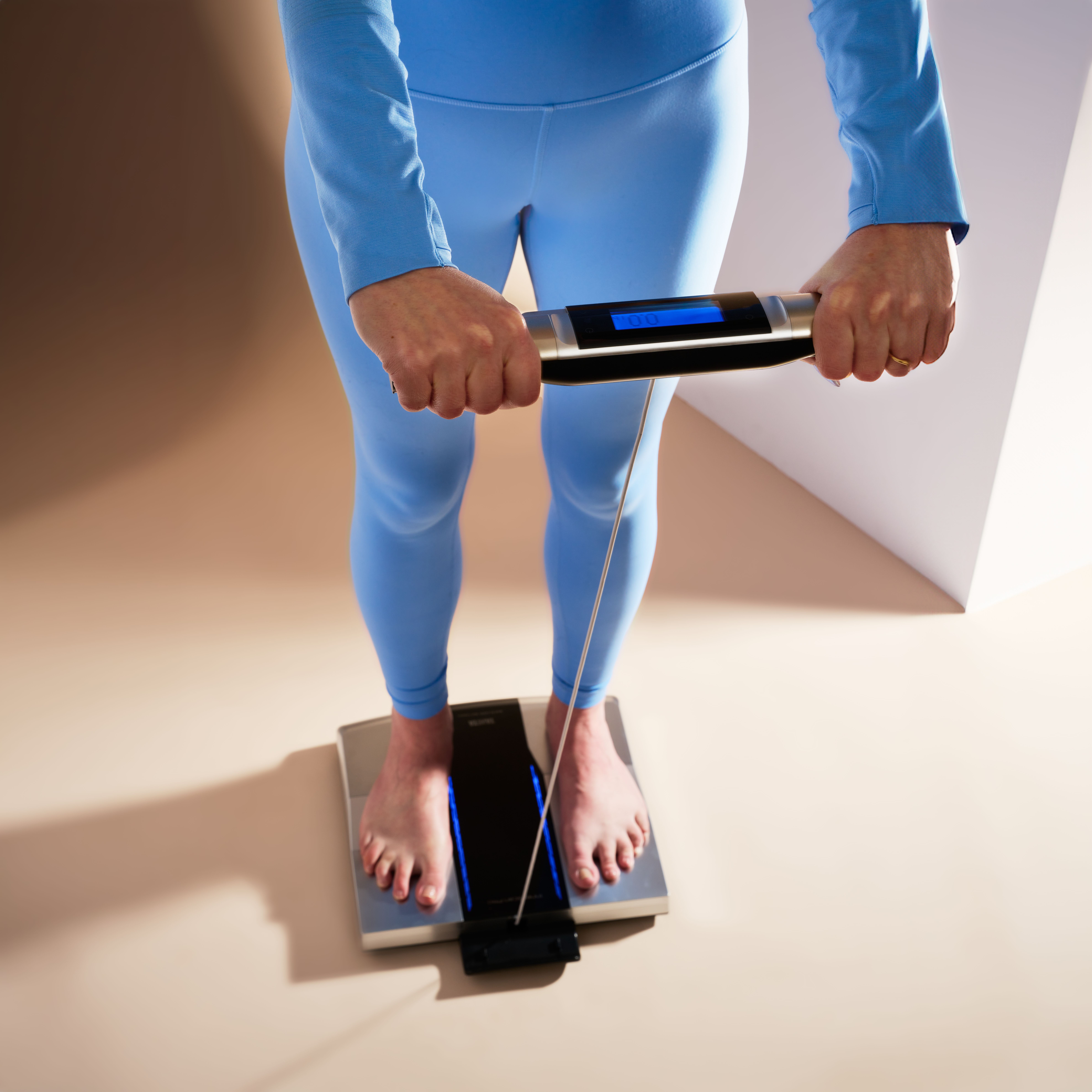
TANITA’s standing “leg-to-leg” BIA measures weight and impedance in a single step while the user stands barefoot on the scale. Gender, height, and age are factored using validated, multi-ethnic equations. It offers the advantages of traditional BIA with greater speed, ease of use, portability, and high reproducibility, making it suitable for hospitals, labs, clinics, health clubs, and home monitoring.
Other Body Composition Technologies
- Magnetic Resonance Imaging (MRI): Maps fat distribution (e.g., visceral vs. subcutaneous) with high accuracy; cost and analysis time limit routine use.
- Total Body Electrical Conductivity (TOBEC): Uses a weak electromagnetic field; highly accurate but expensive and less accessible.
- Computed Tomography (CT): Produces cross-sectional scans to quantify regional fat distribution; clinical-grade equipment and dose considerations apply.
- Air Displacement (Bod Pod): Estimates body composition from displaced air volume; fast but requires specialized, high-cost equipment.
Frequently Asked Questions
Which body fat method is the “most accurate”?
Accuracy depends on how and where the method is being used. Clinical technologies such as DEXA, MRI, CT, and hydrodensitometry generally provide the highest precision because they measure multiple tissue compartments or use imaging to quantify fat directly. However, these methods require specialized equipment, trained staff, and significant cost—making them impractical for routine monitoring.
For everyday use in clinics, fitness centers, and home environments, validated multi-frequency Bioelectrical Impedance Analysis (BIA) offers the best balance of accuracy, repeatability, speed, and accessibility. TANITA pioneered many of the BIA advancements used today, and its research-backed equations and leg-to-leg technology provide results that closely align with reference laboratory methods—at a fraction of the time and cost.
In summary:
- Most accurate in a lab: DEXA, MRI, hydrodensitometry
- Most practical + accurate for routine monitoring: TANITA’s advanced BIA technology
How do hydration and timing affect BIA results?
All BIA devices measure body composition by analyzing how an electrical signal moves through the body, and because water conducts electricity, hydration level can influence the reading. Factors such as recent meals, strenuous exercise, alcohol intake, or unusual fluid shifts may temporarily alter impedance.
To ensure consistency, it’s best to measure under similar conditions—ideally at the same time each day.
TANITA minimizes hydration-related variability in several ways:
- Multi-frequency BIA measures both intracellular and extracellular water for a clearer picture of total body fluid.
- Validated algorithms are designed to compensate for normal day-to-day fluctuations.
- Standing leg-to-leg analysis provides a quick, repeatable method that avoids the placement errors common with adhesive electrodes.
Tip: For the most comparable readings, measure at the same time of day, under typical hydration, and before intense exercise.
Is BMI enough to track health?
No. BMI alone cannot accurately describe body composition or overall health.
BMI only compares height and weight—it does not distinguish:
- Fat mass vs. muscle mass
- Visceral fat vs. subcutaneous fat
- Hydration or fluid shifts
- Bone density
- Metabolic changes over time
A person with a “healthy” BMI may still have high body fat or elevated visceral fat, while a muscular athlete may appear “overweight” on the BMI scale.
TANITA’s body composition monitors go beyond BMI by providing detailed insights into:
- Body fat percentage
- Visceral fat rating
- Muscle mass
- Bone mass
- Total body water
- Basal metabolic rate
- Segmental analysis (in professional models)
These measurements offer a far clearer picture of metabolic health and progress than BMI alone.
By TANITA US
TANITA US is the North American division of TANITA Corporation, the global pioneer and industry leader in Bioelectrical Impedance Analysis (BIA) technology. Founded in Japan in 1944, TANITA has more than 80 years of expertise in developing precision measurement tools and remains the world’s most trusted name in body composition assessment, serving medical professionals, researchers, athletes, and health-focused consumers in over 120 countries.