Beyond DEXA: The Science That Makes TANITA Scales More Accurate
Most body-composition scales are calibrated to DEXA — the medical body scan most people think of as the gold standard. But there's actually a more accurate method that researchers trust above DEXA: the 4-Compartment (4C) method. TANITA is one of the few consumer brands that calibrates its scales against 4C, which is why our multi-frequency analyzers show 99% agreement with this research-grade benchmark.
By TANITA US
TL;DR: Most body-composition scales are calibrated to DEXA — the medical body scan most people think of as the gold standard. But there's actually a more accurate method that researchers trust above DEXA: the 4-Compartment (4C) method. TANITA is one of the few consumer brands that calibrates its scales against 4C, which is why our multi-frequency analyzers show 99% agreement with this research-grade benchmark.
Your body is four things
To measure body composition accurately, you have to be clear on what you're actually measuring. Your body breaks down into four basic compartments:
- Fat — the part most people are tracking
- Water — both inside and around your cells
- Protein — primarily muscle and other lean tissue
- Minerals — mostly bone
Add those four things together and you have you. The more accurately each one can be measured independently, the more accurately you can describe what's happening in your body — whether you're losing fat, gaining muscle, retaining water, or losing bone density.
What DEXA actually does — and what it doesn't
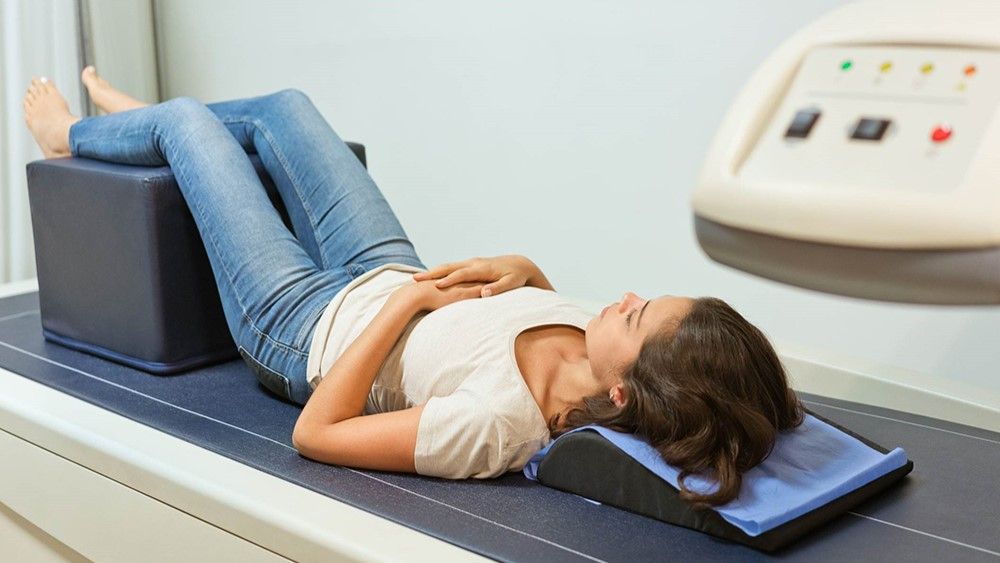
DEXA, sometimes called a "body scan," is the body-composition test most people have heard of. It uses low-dose X-rays to measure bone, then estimates everything else based on assumptions about how fat and lean tissue absorb the X-rays.
DEXA is excellent. It's used in clinical research and athletic facilities all over the world. But it has a small limitation: it assumes that everything that isn't fat behaves roughly the same way, with similar hydration and density.
For an average, healthy adult, that assumption mostly holds. For athletes, older adults, anyone over- or under-hydrated, or anyone outside the population average — it doesn't.
DEXA isn't actually the gold standard. It's a respected reference, but the reference above DEXA is the 4-Compartment method.
What the 4-Compartment method does differently
The 4-Compartment (4C) method doesn't assume. It measures.
It combines four independent readings — body density (from underwater weighing or air-displacement), total body water (from a traceable isotope), bone mineral content (from a DEXA scan), and weight — to calculate fat mass without leaning on assumptions about anything else. That's why scientists use the 4C method as the benchmark to validate every other body-composition method, including DEXA.
The catch: a true 4C analysis takes hours, costs thousands of dollars, and requires equipment that lives in research labs. It's not something a clinic — let alone a consumer — could ever run at home.
Where TANITA comes in
Calibrating a consumer scale against the 4C method is expensive and slow, which is why most scale brands don't do it. TANITA does.
We feed 4C reference data directly into how our multi-frequency BIA algorithms calculate your body composition. We call this 4C Technology — and it's the reason our multi-frequency analyzers show 99% agreement (R² = 0.99) with a true 4C lab analysis.
In plain terms: when you step on a TANITA multi-frequency scale, you're getting a reading that lines up — to within one percent — with what researchers in a lab would tell you. No hours of testing. No thousand-dollar bill. No specialized equipment. Just the most accurate body-composition reading available outside of a research facility.
Why this matters for you
If you're tracking your health, you deserve to trust the number. A body-fat percentage that's "close enough" doesn't help you make better decisions about training, recovery, or long-term health. A muscle-mass reading that drifts when you're hydrated or dehydrated doesn't tell you what your body is actually doing.
That's the whole point of 4C Technology: every TANITA reading is engineered to reflect what's actually happening in your body — not an average, not an assumption, and not a shortcut.
Want the full technical breakdown? Read our complete article on The Four-Compartment (4C) Method.
By TANITA US
TANITA US is the North American division of TANITA Corporation, the global pioneer and industry leader in Bioelectrical Impedance Analysis (BIA) technology. Founded in Japan in 1944, TANITA has more than 80 years of expertise in developing precision measurement tools and remains the world’s most trusted name in body composition assessment, serving medical professionals, researchers, athletes, and health-focused consumers in over 120 countries.